Most people buy a beautiful oil, smell it once, and wonder why nothing has changed. The answer is almost always method and consistency, not the oil itself.
Essential oils are concentrated. A single drop contains hundreds of aromatic compounds, each capable of interacting with the brain and nervous system in ways that are increasingly well understood by science. But concentration alone does not guarantee effect. How you use an oil, and when, and how often, determines whether it actually works.
This guide covers the main methods, what each one does, and which situations each suits best. No rituals required. Just a clearer understanding of what you are working with.
Thirty seconds of conscious inhalation can initiate a measurable shift in the nervous system. The oil does not need long. You just need to give it your attention.
Why the method matters
Scent reaches the brain faster than any other sense. Aromatic molecules travel from the nose directly to the olfactory bulb, which connects straight to the limbic system, the part of the brain responsible for emotion, memory, and stress response. No detour through the thalamus. No delay.
This directness is what makes aromatherapy genuinely useful rather than simply pleasant. The same oil used differently produces a different quality of effect. Diffused across a room, it creates a slow ambient shift. Inhaled directly, it works faster. Applied to the skin, it combines scent with touch and absorption.
Essential oils engage the limbic system through olfactory pathways, producing measurable effects on emotional state, cortisol levels, and autonomic nervous system activity. View source →
Direct inhalation
This is the fastest and most immediate method. Apply a few drops to a tissue or an inhaler stick. Bring it close and breathe slowly for twenty to thirty seconds.
The key is the breath itself. A slow inhale for four counts, a brief hold, then a long exhale for eight counts. The extended exhale activates the parasympathetic nervous system, the branch responsible for calm. Paired with a grounding or calming oil, the effect compounds.
Slow breathing with extended exhalation activates the parasympathetic nervous system and measurably reduces cortisol levels. View source →
Best for: moments of acute stress, mental fatigue, or when you need to shift your state quickly and quietly. Works at a desk, in a car, before a meeting.
Room diffuser
A diffuser disperses aromatic molecules into the air over an extended period, creating a sustained effect on mood and atmosphere rather than an immediate shift. This suits focus work, sleep preparation, and any situation where you want a consistent ambient influence rather than a concentrated dose.
Add fifteen drops to the water reservoir and run it for thirty to sixty minutes. Longer is not always better. The olfactory system adapts to continuous scent, so intervals work well: thirty minutes on, thirty off.
Best for: bedrooms during the wind-down hour, home offices during work sessions, living spaces when the day has been difficult.
For sleep, Lavender oil and Roman chamomile oil diffused thirty minutes before bed supports the transition into rest.
For focus, Rosemary oil or Peppermint oil during morning work hours keeps the mind alert without caffeine.
For recovery, Frankincense oil or Bergamot oil in the evening supports emotional settling after a demanding day.

Portable diffuser
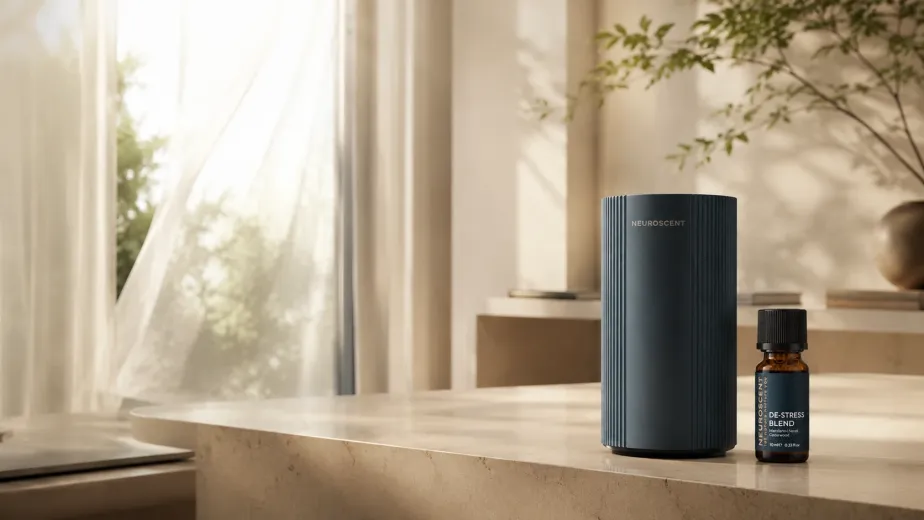
A portable diffuser disperses oil in its pure, concentrated form without water. This makes it more potent than a standard room diffuser and far more practical for use outside the home. It fits in a car cup holder, sits on a desk, travels in a bag.
Attach the blend bottle directly to the diffuser head and switch it on. Use it during a commute, between calls or during any transition point in the day when a reset would help. Fifteen to twenty minutes is enough.
A portable diffuser turns any space into a personal reset point. The oil does the work. You just need to be present for it.
Aroma patches
Patches are underused and underrated. They carry a protective barrier, so the oil does not absorb into skin or fabric. Add one to two drops of your chosen blend, attach the patch to clothing, a collar, or a cuff, and the aroma stays gently present throughout the day.
The effect is subtle rather than concentrated. That is the point. Unlike direct inhalation, which gives you a deliberate shift, a patch works in the background. Each time you notice the scent, you have a prompt to return to your breath.
Best for: travel, long meetings, situations where you cannot pause to inhale directly but still want the quiet support of a grounding or calming oil.
Topical application with a carrier oil
Essential oils are too concentrated to apply directly to skin. Always dilute. A standard ratio is twenty drops of essential oil to twenty millilitres of carrier oil, such as jojoba, apricot, or coconut. Jojoba is particularly well suited because it is lightweight, absorbs cleanly, and does not compete with the aroma of the blend.
Apply to the wrists, temples, the back of the neck, or along the shoulders. The skin absorbs the botanical compounds while the scent reaches the brain through inhalation. Touch and breath working together produce a different quality of effect than either alone.
Topical application of diluted essential oils produces measurable physiological effects through both transdermal absorption and simultaneous olfactory stimulation. View source →
A slow self-massage along the neck and shoulders while breathing consciously is one of the more effective ways to help the nervous system release tension that has accumulated through the day.
Bath soaking
A warm bath combines three mechanisms at once: steam inhalation, transdermal absorption through warmed and open pores and the parasympathetic effect of heat itself. Add eight to ten drops of your chosen oil to a tablespoon of carrier oil first, then add to the water. This prevents the concentrated oil from sitting undiluted on the skin.
Use a calming blend: lavender oil, Roman chamomile oil or marjoram oil. Run the bath slightly cooler than usual if sleep is the goal, since a drop in body temperature after warmth supports the natural onset of sleep.
Warm bathing one to two hours before sleep accelerates the drop in core body temperature associated with sleep onset, improving both sleep quality and subjective restedness. View source →

Aroma jewellery
Pendants and bracelets with an absorbent element allow you to carry a personal scent anchor throughout the day. Apply one to two drops to the absorbent surface, allow it to soak in fully before wearing, and reapply when the scent fades.
Each time you notice the aroma, it becomes a micro-prompt: a moment to return to your breath, to slow down, to recalibrate. This is not about fragrance. It is about creating a reliable sensory anchor that your brain learns to associate with a particular state.
Which oil for which purpose
The method matters, but so does the oil. These pairings reflect the strongest research evidence.
Peppermint and rosemary aromas improved speed and accuracy on cognitive performance tasks in healthy adults. View source →
Consistency is the real method
The most common reason aromatherapy does not work for someone is inconsistency. One use gives a momentary shift. Regular use over two to three weeks begins to create a conditioned response. The brain learns to associate a particular scent with a particular state, and starts preparing for that state when it detects the scent.
This is not placebo. It is how sensory conditioning works. The same mechanism is used in performance psychology and clinical settings. The oil becomes a reliable cue, not a one-off experience.
Choose one blend. One method. Use it at the same time each day for three weeks. That is when it stops feeling like something you are trying and starts feeling like something that works.
A few practical notes
Less is more. Essential oils are highly concentrated. Two to three drops in a diffuser is enough. Five to six drops in a carrier oil for topical use. More does not produce a stronger effect. It produces a harsher one.
Citrus oils and sunlight. Bergamot, lemon, and other citrus oils can increase skin sensitivity to UV light if applied topically before going outside. Look for FCF-labelled bergamot, which has the photosensitive compound removed.
Pregnancy and specific health conditions. Some essential oils are not appropriate during pregnancy or alongside certain medications. If this applies to you, check with a healthcare professional before use.
Pure oils only. A synthetic fragrance oil and a pure botanical essential oil are not the same thing. Synthetic oils may smell similar but will not produce the same physiological effects. The active compounds are either absent or present at levels too low to matter.
RESEARCH REFERENCES
[1] Farrar AJ et al. (2020). Clinical aromatherapy. Disease-a-Month. https://www.ncbi.nlm.nih.gov/pmc/articles/PMC7520654/
[2] Zaccaro A et al. (2018). How breath-control can change your life: A systematic review on psychophysiological correlates of slow breathing. Frontiers in Human Neuroscience. https://www.ncbi.nlm.nih.gov/pmc/articles/PMC5575449/
[3] Haghayegh S et al. (2019). Before-bedtime passive body heating by warm shower or bath improves sleep quality. Sleep Medicine Reviews. https://www.ncbi.nlm.nih.gov/pmc/articles/PMC6111521/
[4] Liang J et al. (2023). Essential oils: Chemical constituents, potential neuropharmacological effects and aromatherapy. Pharmacological Research. https://www.sciencedirect.com/science/article/pii/S2667142522001695
[5] Koulivand PH et al. (2013). Lavender and the nervous system. Evidence-Based Complementary and Alternative Medicine. https://pubmed.ncbi.nlm.nih.gov/25238714/